Mostrando entradas con la etiqueta vivienda. Mostrar todas las entradas

28.3.14

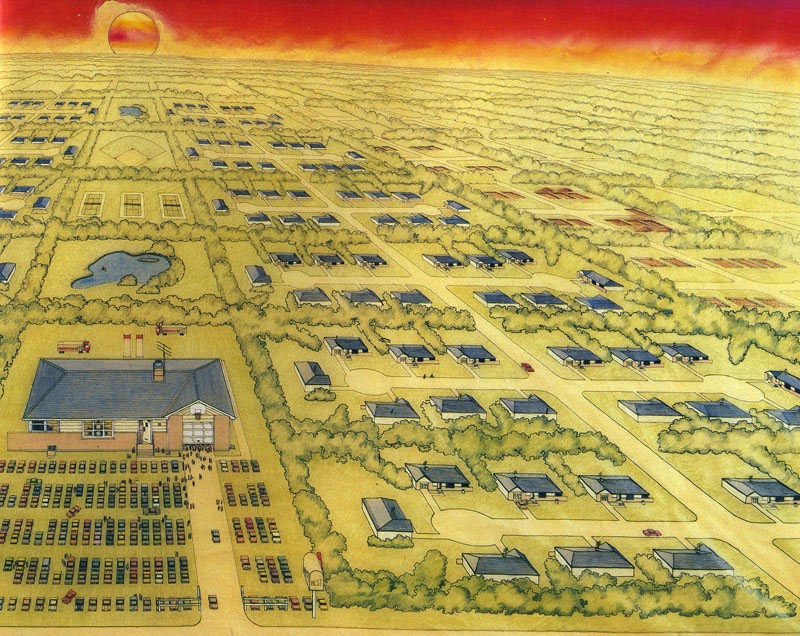
1979 1980 "The Best Home of All" [Stanley Tigerman] Buildings for BEST Products Exhibition.


"Since World War II (an unbelievable 35 years ago) the United States of America has quietly been nurturing a typological evolution as homespun as John Wayne- the suburban house. The objecthood of this form is as solidly as Frank Lloyd Wright- embracing the hip roof (replete with overhangs), the corner window and the wing wall (both of which represent vestiges of Wright's breakup of the square, symmetrically axial, 19th-century aristocratic European box).
Now the suburban house has an identity of scale as solidly real as the brick. By now, almost the entire recent generation-come-of-age has experienced the suburban context -the Hilberseimer Tee-Plan brought into being in all of this continent's Levittised environments. Iconographically, the suburban house is as American as television (God knows, all its aerial search-and-sweep the sky like so many centipedal antennae). Only one very small, alien elements cloud the otherwise clear azure dome over suburban America -the uneuphemized, uncleansed, naked capitalist without any emperor's clothes at all- the commercial strip shopping center.
And so it was that the Best search for a new home began. Really, they just had to find a comfortable place - one that could kind of nuzzle up to its little friends, so that when they came out to shop it would be as if they had never left home. If they drove to the store, why, they could just park their car right on the front lawn. The Best mailbox would be just like their very own, only four times as big. The garage door would be partially open, just like their own broken one, and the front door would be invitingly open as well, revealing an American-dream-come-true-at-last... A 22' tall beckoning fair one as American and as wonderfully wholesome as Mary Tyler Moore. From the highway, their Best new home would settle contextual arguments once and for all, and you would never even really notice that each front step was 32' high, that the  front door was 12' wide x 26' 8'' high, that the downspots were 16" in diameter, that each brick was 15" high x 32" long (with 1 1/2" mortar joints), and that you would walk right by the areawell-as-bench right into the basement window-as-door.
Nearly the Best part of all was the four seasons. Halloween would feature a 10' black cat peering from behind the draped living-room window, with 20' corn shocks on the lawn and a grinning 8' jack-o'-lantern sitting right there on the front stoop.
At Christmas time 16" lights would be strung around the picture window revealing a 25' Christmas tree - and on the roof, a 25' Santa, sleigh, and reinderr. Easter would find 4' tall bunny-rabbits hopping up and down on the lawn searching for colorful 12" Easter eggs hidden between cars. But the Best season of all would be the Fourth of July. A 24' American flag would join the rest of the neighboring flags in celebrating America's birthday. Red and white stripped bunting would surround the garage door, and a 16' wide x 32' long x 10' high picnic table would be found at rest in the driveway, with a 12' high Weber grill nearby.
Of course, the very Best thing about their home lay in its neighborliness, insofar as they had finally found an American symbol right ther where they least expected it - at home in the suburban United States of America - and all the snotty bastards in the urban United States were simply green with envy."


Tigerman, Stanley: "The Best Home of All" en: "Buildings for Best Products", Museum of Modern Art, New York, 1979, p.22-25.

5.12.09

1971 73 House of the Century [ANT FARM]


Esta es una de las casas del futuro más famosas... iré colgando algunos de los ejemplos de casas denominadas por sus creadores como "del futuro"...


Este proyecto fue encargado por una joven familia adinerada (Marylin y Alvin Lubetkin) enamorada del trabajo de Ant Farm que dieron carta blanca al grupo para proyectar una casa de fin de semana. Llamada “La casa del siglo”, fue construida en ferrocemento, de manera artesanal y evocando arquitecturas orgánicas ya experimentadas por el grupo en arquitecturas neumáticas más ligeras. La casa fue publicada en la revista Progressive Architecture, de la que recibió un premio y presenta una gran serie de documentos publicitarios (además de su provocativo nombre) para exaltar su capacidad de futuro que le haga convertirse en la casa del siglo (de 1972 a 2072).


Bibliografía:
01 Progressive Architecture Junio 1973
02 ANT FARM Berkeley Museum HYX Editions [2007]

15.7.08

Catálogo [4] LA VIVIENDA PÚBLICA EN EL FUTURO


Catálogo elaborado por David Pérez García y Patricia Esteban (muchas gracias!, se puede considerar catálogo robado) para el ciclo “LA VIVIENDA PÚBLICA EN EL FUTURO” formato Cine Club del 06 Encuentro Internacional FORO CIVITAS NOVA 2006 http://encuentro.forocivitasnova.org/web/interface_foro.html
Se han seleccionado los apartados:

VIVIENDA AUTOMÁTICA / VIVIENDA FUTURA / VIVIENDA PORTÁTIL

01 - El hotel eléctrico (1908) Segundo de Chomón. España Francia
02 - El inquilino diabólico (Le locataire diabolique, 1909) Georges Méliès. Francia
03 - Una semana (One week, 1920) Buster Keaton. EEUU
04 - La casa electrica (The electric house, 1922) Buster Keaton. EEUU
06 - Metropolis (Metropolis, 1927) Fritz Lang. Alemania
09 - L'Atalante (L'Atalante, 1934) Jean Vigo. Francia
10 - La vida futura (Things to Come, 1936) William Cameron Menzies. Gran Bretaña
17 - Planeta prohibido (Forbidden planet, 1956) Fred M. Wilcox. EEUU
21 - Mi tío (Mon oncle, 1958) Jacques Tati. Francia
31 - Lemmy contra Alphaville (Alphaville, 1965) Jean-Luc Godard. Francia Italia
33 - Farenheit 451(Farenheit 451, 1966) François Truffaut. Gran Bretaña
34 - Las que tienen que servir (1967) José María Forqué. España
35 - 2001: una odisea del espacio (2001: A Space Oddysey, 1968) Stanley Kubrick. EEUU GB
36 - Barbarella (Barbarella, 1968) Roger Vadim. EEUU
38 - THX 1138 (THX 1138, 1971) George Lucas. EEUU
40 - Naves misteriosas (Silent running, 1972) Douglas Trumbull. EEUU
41 - Pink Flamingos (Pink Flamingos,1972) John Waters. EEUU
42 - Solaris (Solaris, 1972) Andrei Tarkovsky. Rusia
43 - El dormilón (Sleeper, 1973) Woody Allen. EEUU
44 - Zardoz (Zardoz, 1974) John Boorman. Gran Bretaña
51 - Blade Runner (Blade Runner, 1982) Ridley Scott. EEUU
49 - La fuga de Logan (Logan's run, 1976) Michael Anderson. EEUU
50 - Stalker (Stalker, 1979) Andrei Tarkovsky. Rusia
53 - Videodrome (Videodrome, 1983) David Cronenberg. Canada EEUU
55 - Brazil (Brazil, 1984) Terry Gilliam. Gran Bretaña
60 - Regreso al futuro II (Back to the future Part two, 1989) Robert Zemeckis EEUU
62 - Desafío total (Total recall, 1990) Paul Verhoeven. EEUU
64 - Delicatessen (Delicatessen, 1991) Marc Caro y Jean pierre Jeunet. Francia
73 - Gattaca (Gattaca, 1997) Andrew Niccol. EEUU
74 - El quinto elemento (The fifth element, 1997) Luc Besson. Francia
77 - Pi (Pi, 1998) Darren Aronofsky. EEUU
83 - Inteligencia artificial (Artificial Intelligence, 2000) Steven Spielberg. EEUU
88 - Minority Report (Minority Report, 2002) Steven Spielberg. EEUU